I’m several weeks into living as a digital nomad in my home town. As can be seen from the calendar, I’m successfully hacking the city, numerous times a day.
(For those of you who haven’t kept up, I spent 2017 and the first half of this year, traveling the world with some self-styled ‘digital nomads,’ researching the future of work, ‘learning by doing,’ and seeing All of the Things.)
Now that I’m home, the project continues.
On Wednesday I attended Experimenta Social’s wearable technologies event, where the amazing Dr Leah Heiss, talked about her current projects, the commercialisation pipeline and how she arrived at her career and PhD in designing what you might call ‘medical jewellery’.
Below is an image of a prototype jewell for delivering insulin.
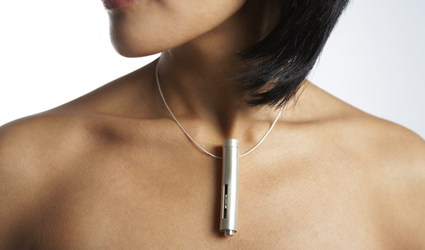
Experimenta have been one of my favourite sources of ideas, possibilities, artefacts and images of the future since I was a university student. This year, they have just one more social in the calendar. For those of you microhacking (the eat, drink and learn afterwork crew and the nomads of Melbourne), this one is a top spot.
I first met Leah at an event called Human 2.0
It’s people like Leah who’ve made me realise that the aspirations I had to becoming a fashion designer when I was a teenager, that were crushed out of me as impossible, by people who had the best of intentions, haven’t ever really gone away in any meaningful sense.
They’ve been sublimated into my career as a public sector problem solver and someone who researches, consults on, designs and implements change and business improvement.
Imagine a world in which your heart rate monitor wouldn’t look out of place at fashion week, and in which your hearing aids can be colour-coordinated to your outfit, in which medical devices are attractive and beautiful objects and not flesh-coloured, ugly looking lumps and bumps.
Leah’s Facett hearing aid design, which is being sold by Blamey Saunders Hears, and is inspired by the geological collection housed at the State Museum, is so much more than that.
One of the greatest health challenges treating practitioners face is patient compliance.
The teenager who won’t take their medication because it’s uncool. The elderly ambulant who doesn’t always wear their falls button when they get up at night because it’s cumbersome to put on. The self consciousness that comes from having a heart rate monitor strapped to you, when you’re at work and going about your ‘normal’ day.
Jewellery functions as an outward expression of the self. It says things about your taste and who you are, that can be read by people from a distance. It signals something more than the sum of its parts. To be great, a piece of jewellery should touch the heart of the wearer, and say something to the wider world that needs no words to be read and understood. It can be quite profound (‘I am married’ for example.)
Leah is aiming to turn functional devices into attractive items that people want to wear and that other people seeing them will admire as beautiful creations.
Design is more than just aesthetics. It’s a way of looking at the world that strives for simplicity and efficiency, improved and better functionality, the way materials and shape and form contribute to or detract from an end result.
If you’ve ever watched an elderly relative change the battery in their hearing aid, or been asked to change one, imagine a world in which you’ve waited several days in deafness, because taking a new battery out of a blister pack is just too fiddly for you to manage at your age.
A ninety year old has less than perfect hand/ eye coordination. The default design of hearing aids, the design of battery blister packs and the trouble that even sighted people have in changing them over – because it is fiddly and easily muckable: (tell me I’m the only one who’s put the the old and the new battery down side by side and not know which one is which) and the picture of the problems that Leah is aiming to solve becomes clear.
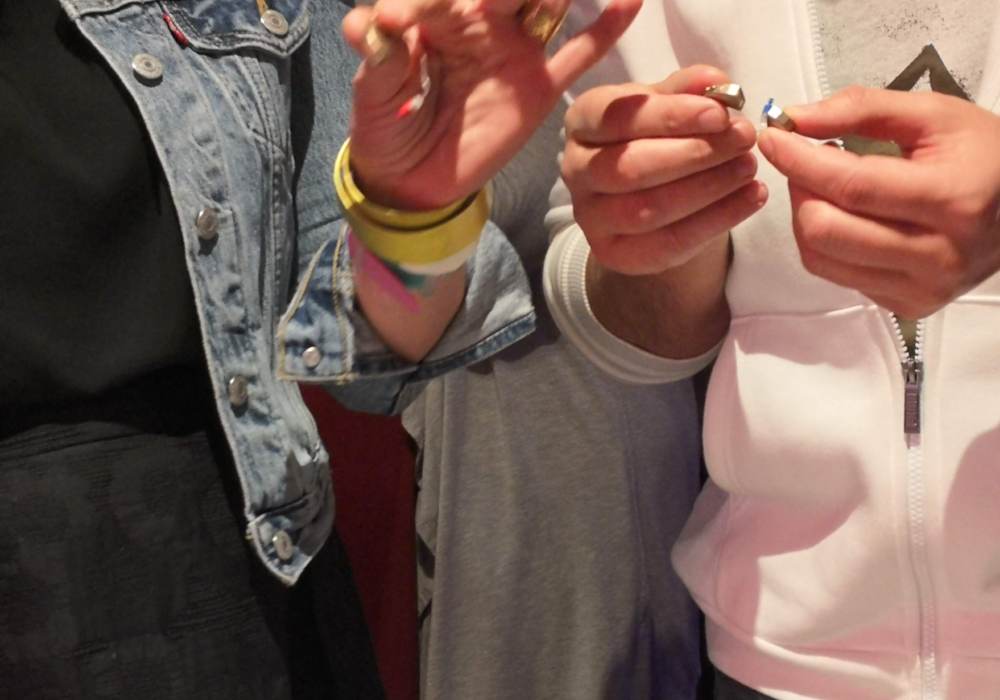
Leah’s hearing aid design incorporates magnetised rechargeable batteries that snap in and out and form the entire lower half of the hearing aid.
The batteries dock in a kidney shaped box reminiscent of the hearing aid’s shape. This acts as a visual reminder to anyone looking at it what the box is for and what it does, which is helpful. You only need to look at it to know that it belongs with the hearing aid.
Because they’re magnetised is becomes more difficult to accidentally drop one and it becomes easier to pick it back up again.
This is brilliant engineering that resolves a real world problem.
Love it!
-37.822049
144.967635


 Bring out the big guns, this one’s for everyone.
 Tech and the City
You must be logged in to post a comment.