Every rose has its thorns…

I made the mistake this week of “upping my game” and attending two tech events that the experts hosting them described as “entry level.”

Unless post graduate, PhD, or decade-plus experience counts as the new “entry level,” they definitely were not “entry level.”

At one event, I hoped to understand the state of play with machine learning, specifically, its approach to causality. Without going into a yuge amount of detail, causality has huge implications for AI, decision support, risk management and crisis response management and the planning thereof, assuming it actually works. So, does it?

I was informed that this would be “the Wikipedia article version” of said subject, and I probably grasped about half of what was said.

I’m going on the record with my disappointment that data analysis still rests on statistical assumptions, that I don’t want it to rest on.

I want real data. Thanks.

If machines are programmed to work things out the way we already do given our existing limitations, such as our assumptions, then they’re only thing to make the same mistakes that we already do, on a larger scale.

At the second event, (which was the first chronologically speaking) it’s difficult to know who the audience is.

I appreciate that information technology operations are highly detailed, and constantly changing, but I’m not the only one here sitting in total dumb-foundedness at the monotonous monologue that issues from the presenter’s mouth, (never an effective move). We sit through whatever this is without the examples that were promised making this tedious and effortful. There is no reason that the words that are tumbling out have been chosen and if the configuration of Azure has been done correctly then a lot of this noise is unnecessary as it won’t let me deviate or depart from the process flow.

I grasp the idea of “virtual machines” and also containers, and the difference between them, and why you might choose one and not the other, by googling the answer.

I grasp that Azure is Microsoft’s cloud storage product, several times over (but not much else,) and the chairs we’re seated in, at this brand new HQ, are so wildly uncomfortable that my backside goes numb in record time, forcing me to have to sit to one side and then the other. (As a rule, I wouldn’t normally admit to any bodily discomfort at a public function, least of all in a public forum, but this was remarkable.)

Get rid of the chairs! Their backs flex.

At least one of the challenges facing technologists, (and confronting me as a communicator, on a regular basis,) is the unfortunate habit of re-purposing words that already have a popular meaning, to mean their opposite, (for example ‘hack’) or something that they just do not mean, for example ‘policy’.

(Sidenote. Dear IT industry. Is there an app for coming up with new words, perhaps using Greek, Latin, or Norse, or some non-US English modern language roots, that you might be able to deploy to make new meaning-filled, technically accurate words?

For inspiration, please refer to ‘The Surgeon of Crowthorn’ and the method etymologyists use to unpack and come up with word forms. Thx)

More than once my purpose on a project has been to explain in lay terms how the information system either is or isn’t going to work the way that management thought it might, whilst co-designing the human, manual, prerequisite inputs, interim and subsequent steps and workarounds that make up a process workflow.

In that role, in an Azure environment, I would be at pains to explain that what I.T. means when it uses the word ‘policy’ does not meet the test of a policy is, and that what they’re describing as a “policy” is at most”a business rule.”

I work in government environments. As you might imagine, they already struggle with ‘big p’ and ‘little p’ policy, by which they mean

  1. public policy: “we shall have a transport system funded by taxes and administered by departments” and
  2. corporate policy “Employees are responsible for securely holding their ID pass, reporting its lost and not allowing its misuse”.

A policy, big or little, is a statement of principle.

As examples go: ‘Thou shalt not kill’ is a pretty good one. (Also, fairly universal. It doesn’t need to be a law for people to go, hey, yeah, I can remember not to do that.)

‘Be a good person’ is another one.

Don’t misuse the corporate resources is another.

Public or corporate, policies are like the Ten Commandments, both in the sense of portent and serious consequence they convey, and how few of them one requires.

I am afraid, my dear Microsoft, that a list of permitted websites and a second list of prohibited ones, are not in any meaningful sense of the word a ‘policy,’ let alone two separate policies.

What they are, is a set of dot point specifics made pursuant to IT security rules, and the higher level principle, or policy that we don’t allow staff to access inappropriate content, whether that content is illegal, obscene or malicious, or only prospectively so.

If you would like help in defining your business rules and mapping these to policy, as part of your corporate governance and its technical manifestations, I am available for hire.

 

PsychTalks: is everything we’ve been told about happiness, wrong? 8 November

My theory that everything you wanted to know will eventually be offered as a free event in Melbourne is proving true. You *could* go to The School of Life, and splash a bit of cash, or, you can sign up and meet the researchers at Unimelb.

Register here

Today 10.30AM VTIC Webinar – GDPR, with Vic Principal Solicitor

Facilitators:

James Stephens, Principal Solicitor, Victorian Government Solicitor Office

A Representative from the Clemenger BBDO to discuss the marketing aspects

Rohish Gupta, Policy Manager, VTIC

The European Union General Data Protection Regulation (GDPR) and the Australian Privacy Act 1988 have many shared common requirements however there are some notable differences, a key one being certain rights of individuals including “the right to be forgotten” which do not have an equivalent right under the Privacy Act.

https://www.vtic.com.au/event-directory/vtic-webinar-series/

eHealth A real-world look at how to implement digital workflows into clinical practice – 18 September 2018

One for the health practitioners,  the health administrators and the moderately curious about the future of healthcare. Centres on dentistry, but the principles of transformation are the same. Sales have ended, but fun fact: fifty per cent of sign ups to free events in Melbourne are no shows. If this floats your boat then contact organisers or just turn up and try your luck.

Details here

Digital Coaching@ Yarra Libraries Scanning Photos 1 October 2:40pm

Get help scanning your photos and documents

Want some one-on-one help with scanning your old photos into digital files you can store or share online? Book a librarian for a twenty minute appointment and we’ll help you save your photos to a USB stick. Please bring a USB stick of your own for saving the images.

Bookings essential.

(You do not need to bring a physical ticket with you to this event.)

Free, friendly tax office advice this week at City of Melbourne libraries

It’s not every day that the ATO and its officers are described as “friendly” but here we have it, in print. Several dates and locations in Melbourne when you can go and ask the ATO any questions you like without waiting on hold or making an appointment, as long as they pertain to its online offerings.

The ATO staff can:

  • Assist and support the lodgement of tax returns using MyGov, (N.B. the staff will be unable to lodge a tax return on your behalf.)
  • Demonstrate the use of their digital products and services, and show you how to use the ATO app.
  • Assist with your tax and super questions.

Brochures and support materials will be available.

Sessions will be held at the following locations and times:

  • Southbank Library: Monday 17 September, 12pm to 2pm
  • Kathleen Syme Library: Tuesday 18 September, 12pm to 2pm
  • East Melbourne Library: Tuesday 18 September, 5pm to 7pm
  • City Library: Wednesday 19 September, 12pm to 2pm
  • Library at The Dock: Thursday 20 September, 12pm to 2pm
  • North Melbourne Library: Friday 21 September, 12pm to 2pm

No bookings required, just pop in.

With thanks to the copy writers at City of Melbourne


Online resource: visualising global credit risk

For those of us following the Haynes Royal Commission and wondering just how badly off things might be, unimelb has a recorded a lecture all about that.

Visualising global credit risk


“Will Robots Eat Our Jobs?”

Happy 136th Birthday RMIT!

With a subject as enticing as “will robots eat our jobs?” I found myself mid-morning at RMIT’s green-slimed Storey Hall, expecting a bit of a lecture.

What I got was more.

A whole lot more.

Not only was it the University of Technology’s 136th birthday party, but there was molecular gastronomy on offer.

My goodnesss. It was eye-opening and mouth watering.

From the cater waiters dressed as Pris from ‘Blade Runner‘ to a thirty minute roller skating extravaganza that was part ‘Xanadu‘ and part ‘Starlight Express’, to a panel discussion involving the most animated university Vice Chancellor put on this green earth (Martin Bean) introducing a whole new word to the lexicon.

Meet “micro-credentialing”.

In a world in which you have multiple careers, a freelance economy, and ever evolving technology and capability, it’s exactly what the blog is aiming to wean you onto. Constant short bursts of self development.

Since introducing the concept, RMIT has delivered over 8,000 of the blighters, with the aim of creating a ‘pick and mix’ option for students and return-to-study types, but if you’re not sure you want to commit to these just yet, you can access the blog calendar, or sit at home and try some online offerings like Coursera or the number one educator in the world which I am surprised to learn is ‘YouTube.’ (I mean I get it but I’m not sure that I’d put it in that category.)

This week alone I’ve attended a webinar on programming chat bots with Microsoft UK; a seminar on how to edit Wikimedia and Wikipedia with Andy Mabbet at ACMIT X; learned about the policy ecosystem in Australasia at UniMelb and the Modern workplace at Microsoft HQ, discovering that Australian and state governements are disconnected and seem not to have invested in ways to share knowledge and colloborate on policy, and a business in regional Australia is using Microsoft 365 (the way of the future for shared services) and purely mobile solutions to deliver healthcare to seniors in rural, regional and remote areas of New South Wales.

PHEW.

Telehealth being a pet subject, I’ll be following up on Integrated Living and recommending it to my policy connections in health, tech and gov.

I also visited WanChain at Stone and Chalk who seem to be a middle ware interface or exchange type entity allowing trade between different types of cryptocurrency.

I asked them tricky questions about privacy and health data and we are going to continue the conversation.

Last but not least, I also made a new connection.  The Chief Strategist at Deloitte Australasia Robert Hiliard whose career trajectory includes an interest in letting go of the ‘digital’ descriptor in the transformation space and a short story involving a thirteen year old, a Commodore 64 and an early inventory and accounts management system created from scratch for a furniture retailer in country Victoria.

Disconcertingly, 2 per cent of Chief Executives in Australia think that technology has the capacity to seriously disrupt their businesses.

An alarming 71 per cent think that someone somewhere in the business is (probably) looking into the issue of disruption and the implications of new technologies. (Specifically “that guy with the red hair” to give an example of one of the answers supplied to researchers in response to my exact question, aka ‘who?).

This is really bad news. For so long we have promoted people to the top because of their ability to cut through, or as I prefer to see it, pay no attention to the detail. Speaking as someone who loves complexity and systems design, this has always meant my own career was never going to hit the heights but geez I’ve seen some really incompetent people rise up the ranks.

If these stats are real, Australia is headed for some nasty shocks.

Mr Hiliard is the first person to confirm my previously quietly held concerns that blockchain is “ugly” by which he means there are other  better options in the market that do the same thing better and I mean it seems to be attended by a yuge amount of hype and not a lot of information as to how it is actually better than other options.

(Example: you need US dollars to float an ICO. In laymans’ terms that means you make your digital currency out of existing currency… Why would anyone do that?)

Then there are the calls to regulate and apply the rule of law to these speculative creations, which is fine, except it doesn’t gel with my understanding of these currencies as having been created to avoid “gummint control” and tax, and allow the black market to flourish with some certainty.

So there’s that.

Finally, on the question of whether robots will eat our jobs the consensus seems to be no. They won’t.

At least twice this week the poster child for the future of humans and robots has been cited as two teams of chess players currently kicking goals on the world chess circuit (OMG. Why do you do this to yourselves, technologists?) in which the yuman and the off-the-shelf bot are working collaboratively. The machine doing the routine and predictable behavioural bits, and the creative tactics coming from the higher cognitive reasoning bits of the human’s imagination and brain. I can see how this would help risk management. Specifically my ability to reign in executives making rash decisions. However, I also note that behavioural interviewing (which is a pet hate, because it literally looks backwards, and assumes that we will only ever do what we have only ever done, which is precisely the type of work that machines will eat alive) isn’t interested in the ability of the human to have several careers and be creative. It vitiates against it. It may be what we need, but it’s not how we’re recruiting….

It begs the question whether the guy with the red hair who’s supposedly dealing with the threat of disruption actually exists or is he a figment of our irrationally positive imagination?

oznor


New and improved: Tech and the city calendar

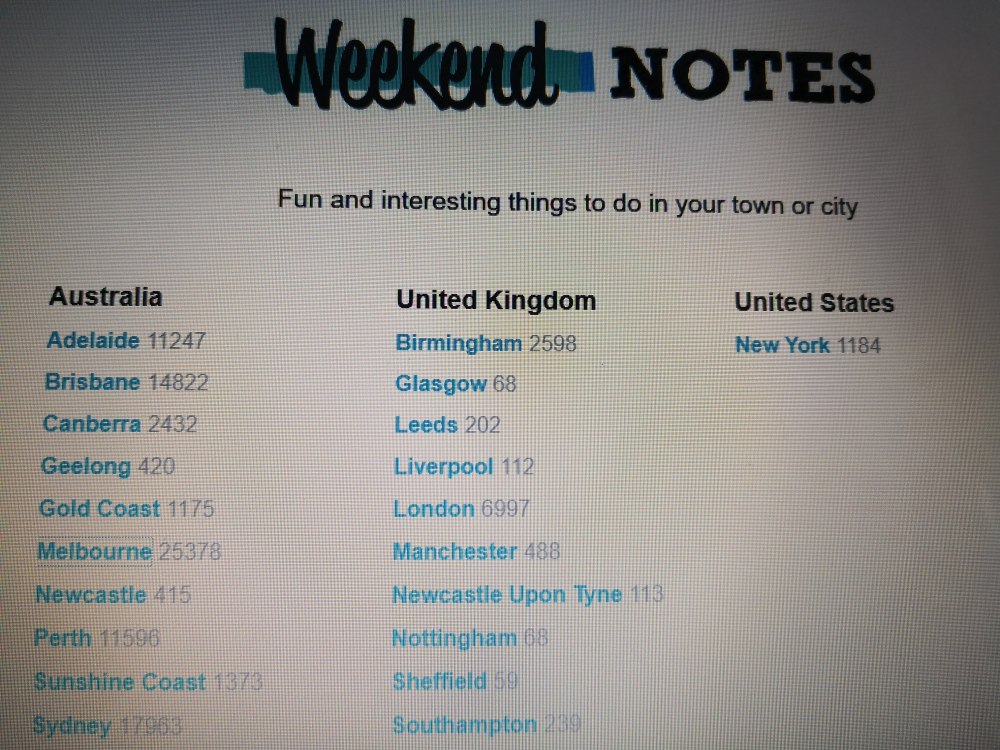
I created a Tech and the City Calendar for digital nomads and corporates wanting to know what’s on in Melbourne.

If you’ve ever wanted to a quick, easy introduction to AI, blockchain, bots, UX, UI, lean start ups, Agile, accelerators, brain science, digital ethics, design thinking, public policy debates, future of work stuff, maker spaces and how to do things like make a web site, be a photographer, record music, scan your photos, print 3D objects, program computers, how the law works, or some kind of one to one digital coaching, these are all freely available to you in Melbourne.

Don’t believe me? The stats don’t lie, and the calendar is updated daily.

cof

Start ups: 12 months free at CreativeCubes.Co

Space: the final frontier.

Startup Victoria are sponsoring TWENTY lucky entrepreneurs for a YEAR at Creative Cubes co-working. Start ups looking for space to work and collaborate with like-minds can pitch for space at two locations on two different dates.

Monday September 17 Richmond or Tuesday October 2 Hawthorn

you’d be mad to miss it. (assuming you’re a start up and you like free rent…)