Tech and the City Calendar | Tech and the City
Choose your own career hacks, Melbourne.
Tech, data, culture, workshops. https://ellebrooker.wordpress.com/tech-and-the-city-free-events-in-melbourne-australia/
Choose your own career hacks, Melbourne.
Tech, data, culture, workshops. https://ellebrooker.wordpress.com/tech-and-the-city-free-events-in-melbourne-australia/

Maker-workshop on Near-Field Communications (NFC) in fashion

Check out this Meetup with Sarah Richards, the force behind Content Design, user centred content and UK.Gov
Presented by the Melbourne Web Accessibility & Inclusive Design http://meetu.ps/e/FW2mz/66ySd/d
This week I became the lucky recipient of a set of Metaverse Makeover nails.
What are Metaverse Makeover nails you ask?
Good question.
Before we get to that though, may I take a moment to dwell on the joy of hearing one’s name called out in a raffle draw?
It’s so unexpected that I would win something in a game of chance, that I am thrilled, and squealing like a child, even though there is a high probability that I will not be using my metaverse nails anytime soon, for reasons I can explain.
To put it simply, they’re fake nails. But, there’s more to them than that. Their point of difference, as explained by their creator, Thea Baumann, an Australian based in China, is a little more complicated.
They are “collectible fashion accessories powered by a 3D app: triggering hologram stickers you can wear, play, snap, and share.”
More significantly, they presage a future in which scanning people, animals, objects with a device will reveal something hidden about them, a bit like Pokemon Go, the next generation.
Imagine a world in which you can portray yourself the way you want others to see you, without limits. Except perhaps for screen size and processing power.
In the future 3D interactive holographics will augment your appearance whenever your wearables interface with the right app. All kinds of animations and effects will attach to you that you can show off and share them with others: starting with your wardrobe and make up: clothing, face and hair, but it could be a body part, a gender or species change; a virtual designer outfit; a character or spider webs an invisible lassoo, or a combination of all of the above.
Thar be dragons, furries, plushies and pony boys and girls. Also a lot of Cosplay.
Think of it as Second Life branching out beyond the confines of its universes, islands and worlds and into your smart phone. Anything that can only be seen in the realm between the online and meat world, or whatever terms you’re personally inclined to call the two locations, when they are not united in the metaverse.
A bit like this BBC TV show is doing with Italian cities.
The interesting thing that Thea has pulled off is to make something holographic dynamically adhere to a small curved surface, that is, a finger nail. In doing the hard yards first, the rest should be a walk in the park. Although it is still a very new and very digital art driven project at the moment.
As I mentioned earlier, there is a high probability that I will not be using my metaverse nails anytime soon, but that’s not their fault at all.
True. In real life the nails are heavy and plastic looking. The ones I’ve selected are neon pink and leopard printed (as opposed to the unicorns featured in the video, which were also an option) and it’s fair to say that they’re not really consistent with the environments I tend to work in, now that I don’t work in the arts. Then there is the fact that I am nearer to fifty than forty which is frankly, disgraceful.
But the bigger reason is that I am a confirmed nail fail.
The only reason I’ve never used fake nails, (and am unlikely to use these ones, aside from enjoying them being in pristine condition), is because I’m told that they leave your real nails in terrible condition. And believe me when I tell you that the last thing my existing nails need is to be even worse off than they are. I stopped biting them when I finished high school and despite another half a lifetime passing by, they remain steadfastly horrible, no matter how much attention and professional care is lavished on them. They are weak, prone to breaking and always uneven. They have a weird shape.
I am impressed by the tech and interested to see who turns out to be the market for pieces and I wonder what the coding and programming skills are that are necessary to design augmented fashion products.
I would love to know and try it out.
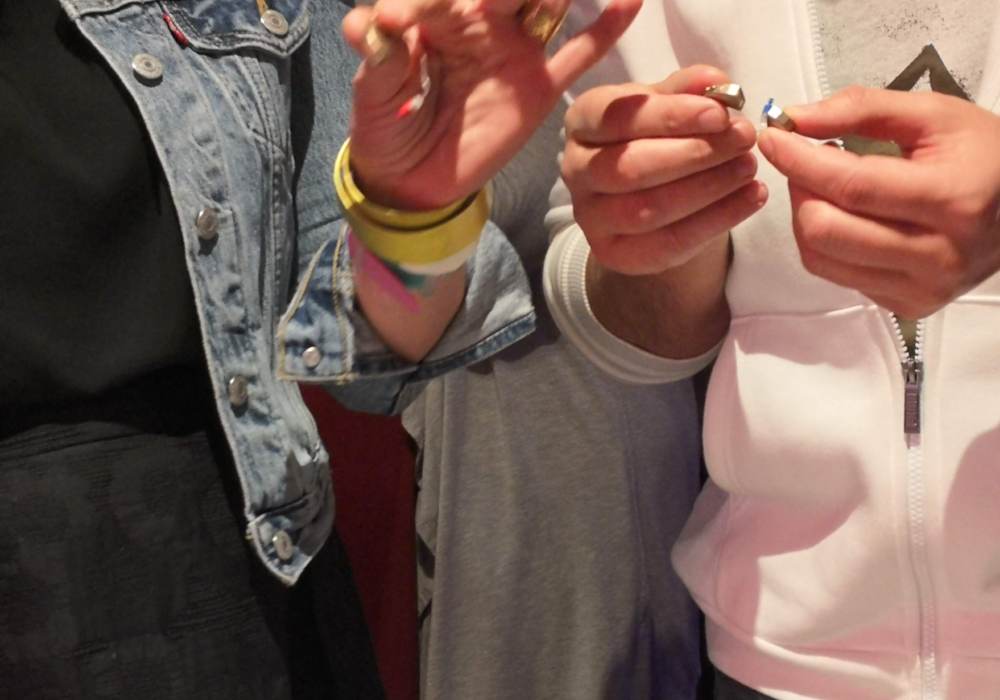
I’m several weeks into living as a digital nomad in my home town. As can be seen from the calendar, I’m successfully hacking the city, numerous times a day.
(For those of you who haven’t kept up, I spent 2017 and the first half of this year, traveling the world with some self-styled ‘digital nomads,’ researching the future of work, ‘learning by doing,’ and seeing All of the Things.)
Now that I’m home, the project continues.
On Wednesday I attended Experimenta Social’s wearable technologies event, where the amazing Dr Leah Heiss, talked about her current projects, the commercialisation pipeline and how she arrived at her career and PhD in designing what you might call ‘medical jewellery’.
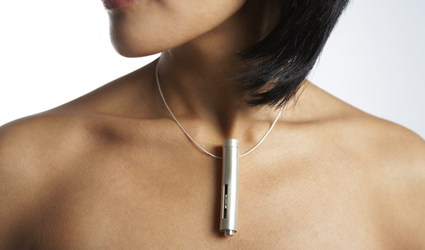
Below is an image of a prototype jewell for delivering insulin.
Experimenta have been one of my favourite sources of ideas, possibilities, artefacts and images of the future since I was a university student. This year, they have just one more social in the calendar. For those of you microhacking (the eat, drink and learn afterwork crew and the nomads of Melbourne), this one is a top spot.
I first met Leah at an event called Human 2.0
It’s people like Leah who’ve made me realise that the aspirations I had to becoming a fashion designer when I was a teenager, that were crushed out of me as impossible, by people who had the best of intentions, haven’t ever really gone away in any meaningful sense.
They’ve been sublimated into my career as a public sector problem solver and someone who researches, consults on, designs and implements change and business improvement.
Imagine a world in which your heart rate monitor wouldn’t look out of place at fashion week, and in which your hearing aids can be colour-coordinated to your outfit, in which medical devices are attractive and beautiful objects and not flesh-coloured, ugly looking lumps and bumps.
Leah’s Facett hearing aid design, which is being sold by Blamey Saunders Hears, and is inspired by the geological collection housed at the State Museum, is so much more than that.
One of the greatest health challenges treating practitioners face is patient compliance.
The teenager who won’t take their medication because it’s uncool. The elderly ambulant who doesn’t always wear their falls button when they get up at night because it’s cumbersome to put on. The self consciousness that comes from having a heart rate monitor strapped to you, when you’re at work and going about your ‘normal’ day.
Jewellery functions as an outward expression of the self. It says things about your taste and who you are, that can be read by people from a distance. It signals something more than the sum of its parts. To be great, a piece of jewellery should touch the heart of the wearer, and say something to the wider world that needs no words to be read and understood. It can be quite profound (‘I am married’ for example.)
Leah is aiming to turn functional devices into attractive items that people want to wear and that other people seeing them will admire as beautiful creations.
Design is more than just aesthetics. It’s a way of looking at the world that strives for simplicity and efficiency, improved and better functionality, the way materials and shape and form contribute to or detract from an end result.
If you’ve ever watched an elderly relative change the battery in their hearing aid, or been asked to change one, imagine a world in which you’ve waited several days in deafness, because taking a new battery out of a blister pack is just too fiddly for you to manage at your age.
A ninety year old has less than perfect hand/ eye coordination. The default design of hearing aids, the design of battery blister packs and the trouble that even sighted people have in changing them over – because it is fiddly and easily muckable: (tell me I’m the only one who’s put the the old and the new battery down side by side and not know which one is which) and the picture of the problems that Leah is aiming to solve becomes clear.
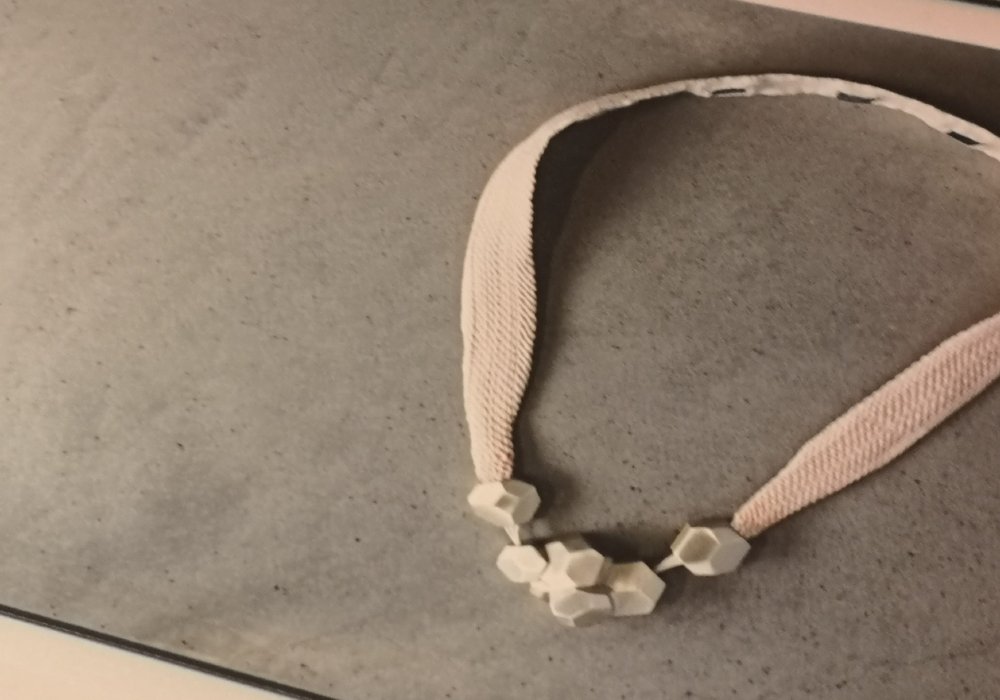
Leah’s hearing aid design incorporates magnetised rechargeable batteries that snap in and out and form the entire lower half of the hearing aid.
The batteries dock in a kidney shaped box reminiscent of the hearing aid’s shape. This acts as a visual reminder to anyone looking at it what the box is for and what it does, which is helpful. You only need to look at it to know that it belongs with the hearing aid.
Because they’re magnetised is becomes more difficult to accidentally drop one and it becomes easier to pick it back up again.
This is brilliant engineering that resolves a real world problem.
Love it!
If you missed Experimenta last night, do not despair. Check out this Meetup with RMIT Innovation and Entrepreneurship Research Group http://meetu.ps/e/FY1LD/66ySd/d
This was the question posed at Deloitte Australia’s ‘Conversation – Designing the Interface of the Future’ event, hosted in conjunction with ‘Disruptors in Tech’, a Melbourne based MeetUp group.
I have to admit, quite what a brand sounds like isn’t something I’ve ever really thought about before.
Close your eyes for a moment.
Imagine a world in which every product in the shop is blaring about itself in natural language. Possibly, even holding a conversation with you, calling you by name, fielding your questions and answering them based on preferences it gleaned from the data that you verbally offered up; your smart devices silently told it (your GPS, purchasing and browsing history); your loyalty accounts, biometrics and even the embedded chip in an existing purchased item that you’re currently wearing, that is interfacing via Near Field Communication, informed it about, all serving as context.
It’s not that far-fetched, but it’s hardly everybody’s idea of Utopia.
I instantly assume that every spokesperson, every brand ambassador and every voiceover talent who ever carved out a career is facing becoming automated, and that an audio apocalypse of the kind ‘Minority Report’ foreshadows is on the cards.
On reflection, I fervently hope that the option to switch to classic mode, by which I mean ‘return to mute’ isn’t overlooked, or else that I can default everything to Patrick Stewart or everyone’s favourite meerkat, Alexsandr Orlov.
(I’d be pretty keen for it NOT to sound like Microsoft Catherine.)
Currently, I’m mid way into a two part webinar, learning how to structure and design text based chat bots, with Microsoft Worldwide online, so this long-ago lecture, (which pre-dates the blog, and is one of its three inspirations,) is starting to resonate with me, but in a way that makes the chat bot idea seem a little bit old fashioned.
Ha!
In my humble opinion, text bots take up far too much on-screen real estate. Especially on mobile. And I say that as someone who loves writing and reading, (but not chatting or instant messaging,). Since I’m on a roll, for the love of all that is good and worthwhile, if I’ve just agreed that your site may install a cookie, my dear UX designers, please don’t follow that up a split second later with a request to take a survey about my experience of the site.
Blink.
You know that I literally don’t have any experience with the site yet, don’t you? I mean, you just installed a cookie a second ago, so it invites the question, complete with raised eye brow, “what experience, prithee?”
For the UX and CX designers confusing metrics with success; high pressure tactics with what people want; bells and whistles with colour and interest; and making account closure more than a two-step process, peppered with mildly threatening, condescending “warnings” that imply I don’t know what it is I’m really doing, I do not need yet another reason to switch to a low footprint lifestyle.
Capiche?
Getting back to the subject at hand….
I think it’s self evident what a Rolex watch would sound like (Roger Federer, obvs.) But what does an Australian shiraz sound like? How about the bus stop timetable? And will the bot have a name, or will it be openly robotic? Devoid of personality?
This event is one of my favourites.
It’s so good, that it’s taken a few weeks to process and decide how to best present it.
This edition of Disruptors In Tech was held at National Australian Bank’s 700 Bourke Street outpost, (not to be confused with its dockside 800 Bourke Street headquarters, or its two or three other Bourke Street properties which, although equally imposing, are also the utterly wrong address for this particular event)* showcases the bank’s thought process and design considerations as it prepares to launch a chat bot.
A bank bot?
Hmm.
I’m unfamiliar with any scenario where I might be so caught up that I have to make an urgent bank transaction and my hands won’t be available, but OK. People do strange things when they’re in transit.
Lessons learned:
1. Designing a conversational user interface (CUI) is more fraught than you think.
Lesson 2: personality is hard to do.
As it happens, creating a bot with a flat personality, or no personality (and no name) is just as complex as its alternative. In having no personality, the bot still has a personality. Just not a very sassy, cool or chatty one.
Compound the problem with an assistant that has to flatly, blandly and consistently cover multiple divisions and myriad product lines of a newly agile, complex business, (with the added bonus that the bank is currently investing its time in realising that being complex is not an excuse for not being a disreputable corporate citizen) and this makes for an interesting case study.
Have they got it right?
Lesson 3: Spoken word is a different animal to text.
Human conversation is less formal, more shorthanded and incomplete than dialogue. As a result, conversation bot chat shouldn’t aim to replicate, or in any way be substantially based on, text.
(The sound of a low flying sunk cost whooshes by, while the trumpet heralding a serious new overhead plays.
Choose your interface wisely.)
I have to say, this is kind of a bummer for enterprise if they jumped on the wrong bandwagon and are being leapfrogged, but it’s a boonoonoonus for those who write and script for a living, because if you installed a chat bot: the kind that pops up in a window, asking “can I help you?” (a bit like Clippy used to do,) under no circumstances should you use it as the basis for your new conversational interface.
If someone is calling about their home loan, you can’t just text-to-voice your website or ‘play to end,’ as that’s not how people converse.
This is because even the punchiest of chat bot text comes across as stuffy and long-winded.
NAB’s bots triage and escalate non-self service problems to actual humans, on the fly, whether the channel is text or voice, ensuring that you don’t have to repeat yourself once you and you’re compound issue are connected.
Lesson 4: Testers will be jesters
The bank found that in testing the feature some customers could not help but test the limits of the bot to answer non-banking related questions such as “how tall is a horse?”
The flat answer this bot provides to such fodder is that it cannot assist with the question, but in principle it could be programmed to answer all questions put to it, one day, once the basics are covered and are up and running beautifully.
End scene.
 Tech and the City
You must be logged in to post a comment.