I landed a contract that sees me drafting a freelance piece about domain name disputes, whilst making a dweeb of myself in a telephone interview for a job that I could do, but it’s not in my industry, or aligned to my background (it’s publishing, albeit a publication about public services, so that’s definitely my patch) and learning to podcast.
Yes, podcast.
I didn’t get the job, I don’t think, but I really do feel energised.
Keep an eye on the calendar for the next learn to podcast at Docklands Library or Kathy Syme, both of which have production studios.
Sarah Richards spent 10 years working in the UK government, rising to head of content design for the Government Digital Service (GDS).
There she developed content design as a discipline for theGOV.UKwebsite and has authoredContent Design, a book for anyone creating user-centred content.
The road to catching up with all the shiny new things continues. This time it’s an ‘Introduction to Agile’ session at RMIT Activator.
The Activator is an incubator and it is the place for getting a brief introduction to almost anything that you’re not quite sure about, and want to get the low down on.
I cannot recommend it highly enough. (Although I do advocate that you BYO tea bags as the kitchen has mugs and hot water but no other provisions.)
RMIT’s Vice Chancellor Mr Bean ushered in the word ‘microcredential’ during the ‘Will Robots Eat Our Jobs‘ event and I’m predicting that RMIT’s teaching innovations will cause its graduates to rapidly rise up the employability rankings, because they’re all about gaining breadth knowledge and real world experience while you study your undergraduate degree.
Yes friends, that elusive mix of management insight and technical skill that universities previously didn’t teach you, because they were hoping you’d do what I did, and come back and do post-graduate studies, is now no longer. Industry has spoken, as has people’s willingness to forgo having a house in favour of paying back study debts, the way some did.
On to the subject at hand though:
TLDR
For a high level, jargon-free version of what Agile is, here’s the Wikipedia entry.
Lean is the mindset or ecosystem Toyota used to come up with ‘Just in Time‘ manufacturing ;
Electronic media is undermining people’s willingness to read, research and accurately understand and correctly cite academic antecedents (like the ones above).
Don’t take the knowledge I earned studying my Masters degree and snort laugh at it!
What did I learn?
That my Masters degree is still golden.
If you, like me, have studied an MBA or a Masters in Public Policy and Management, and taken it seriously (because it’s what you did instead of buying somewhere to live, for example,) then the one new thing and the fun new game that you most need to know how to play is ‘what strange, new name has someone rebranded what *I* learned to?’
The frameworks you know as:
plan do review;
forming, storming, norming, performing;
thin flat teams;
lateral thinking;
Just in Time;
process re-engineering; and
social action research;
(and probably others,) all have fun new names that are designed to make you deeply concerned that you may be out of touch, and irrelevant, when in reality the reverse may be true.
I’d like to think that the investments I’ve made in myself, in my studies and in acquiring wide experience, are at least a respectable match for a training company looking to sell me further professional development.
I have three and a half degrees: two bachelors, a Masters and a half a law degree, and not to harp on it, but they’re all paid for. Instead of doing something sensible, like buying somewhere to live, I learned. I learned a lot. I studied and I read and I compared and I contrasted and I found out the hard way that if you want the really good marks, then you really, really need, as a first port of call, to be capable of sourcing, quoting and citing respectable literature, accurately. This is especially the case, if you’re mounting an argument that completely contradicts your lecturer, and you want to get away with it.
If there is one thing that social media and short attention spans seem extremely ill suited to doing, it has to be the art of writing and researching ideas properly.
Hand on heart, I don’t mind hearing what you have to say, but please, please my millenial friends, don’t pass yourself off as an expert.
Please. Just. Don’t.
If you are someone who:
cannot tell your audience who or what the Deming of the ‘Deming cycle’ slide that you apparently cut and pasted from the internet and just projected on the wall refers to;
have cited both 7 Eleven and Amazon as virtuous paragons of ideal organisational culture several times now; and/or
don’t have any actual software development experience utilising Agile (which is as much as I do know about the origin story of the Agile method*) to speak of because your boss doesn’t think it’s important,; or worse
think that no one has ever given social action research a burl before, to know that it’s controversial; or that it’s been discredited and rejected as expensive, unreliable and open to abuse, we are going to need to work through all of this, before we start to see eye to eye.
I am not up for my everyday existence being turned into a snake oil fume fuelled advertorial from the Woopreneur school of confidence-artistry. I spent close to a year explaining this exact problem, at length, to a cluster of self proclaimed digital nomads who didn’t watch the news, and I am looking forward to being so old that people expect me to be mean and step out in front of cars without looking.
I am asking you to treat me with the respect that I have shown you. And for now at least, I am doing it nicely.
I’m going to go on the record with this, this, this…. objectionable, minimising, dehumanising feeling of being more than just a little put out by the treatment of me as being too old to be taken seriously when I say things like ‘that’s not new‘ to someone who gets all their information from social media, Goop and fictional news breaks featured within sitcoms and movies on Netflix.
Please don’t take the knowledge I earned studying my Masters degree and snort laugh at it. To find you snort laughing at me and my hard work and the hard earned knowledge that it resulted in, is not very nice. It’s ignorant and disrespectful.
What is they say about people who don’t learn the mistakes of history?
Agile is a software development tool, but like all good organising principles it’s just one way of looking at a problem.
It’s origins lie in the problem graphic designers know all too well, that the client doesn’t know what they want, but they do know what they like and wouldn’t it be great if just once everyone was on the same page, so that professionals stopped missing the mark with products that don’t meet client expectations.
ON that note here is something that might help with that. And it’s for clients.
I’m several weeks into living as a digital nomad in my home town. As can be seen from the calendar, I’m successfully hacking the city, numerous times a day.
(For those of you who haven’t kept up, I spent 2017 and the first half of this year, traveling the world with some self-styled ‘digital nomads,’ researching the future of work, ‘learning by doing,’ and seeing All of the Things.)
Now that I’m home, the project continues.
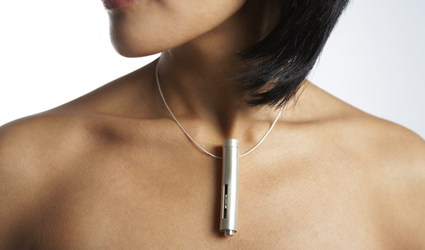
On Wednesday I attended Experimenta Social’s wearable technologies event, where the amazing Dr Leah Heiss, talked about her current projects, the commercialisation pipeline and how she arrived at her career and PhD in designing what you might call ‘medical jewellery’.
Below is an image of a prototype jewell for delivering insulin.
Experimenta have been one of my favourite sources of ideas, possibilities, artefacts and images of the future since I was a university student. This year, they have just one more social in the calendar. For those of you microhacking (the eat, drink and learn afterwork crew and the nomads of Melbourne), this one is a top spot.
It’s people like Leah who’ve made me realise that the aspirations I had to becoming a fashion designer when I was a teenager, that were crushed out of me as impossible, by people who had the best of intentions, haven’t ever really gone away in any meaningful sense.
They’ve been sublimated into my career as a public sector problem solver and someone who researches, consults on, designs and implements change and business improvement.
Imagine a world in which your heart rate monitor wouldn’t look out of place at fashion week, and in which your hearing aids can be colour-coordinated to your outfit, in which medical devices are attractive and beautiful objects and not flesh-coloured, ugly looking lumps and bumps.
Leah’s Facett hearing aid design, which is being sold by Blamey Saunders Hears, and is inspired by the geological collection housed at the State Museum, is so much more than that.
One of the greatest health challenges treating practitioners face is patient compliance.
The teenager who won’t take their medication because it’s uncool. The elderly ambulant who doesn’t always wear their falls button when they get up at night because it’s cumbersome to put on. The self consciousness that comes from having a heart rate monitor strapped to you, when you’re at work and going about your ‘normal’ day.
Jewellery functions as an outward expression of the self. It says things about your taste and who you are, that can be read by people from a distance. It signals something more than the sum of its parts. To be great, a piece of jewellery should touch the heart of the wearer, and say something to the wider world that needs no words to be read and understood. It can be quite profound (‘I am married’ for example.)
Leah is aiming to turn functional devices into attractive items that people want to wear and that other people seeing them will admire as beautiful creations.
Design is more than just aesthetics. It’s a way of looking at the world that strives for simplicity and efficiency, improved and better functionality, the way materials and shape and form contribute to or detract from an end result.
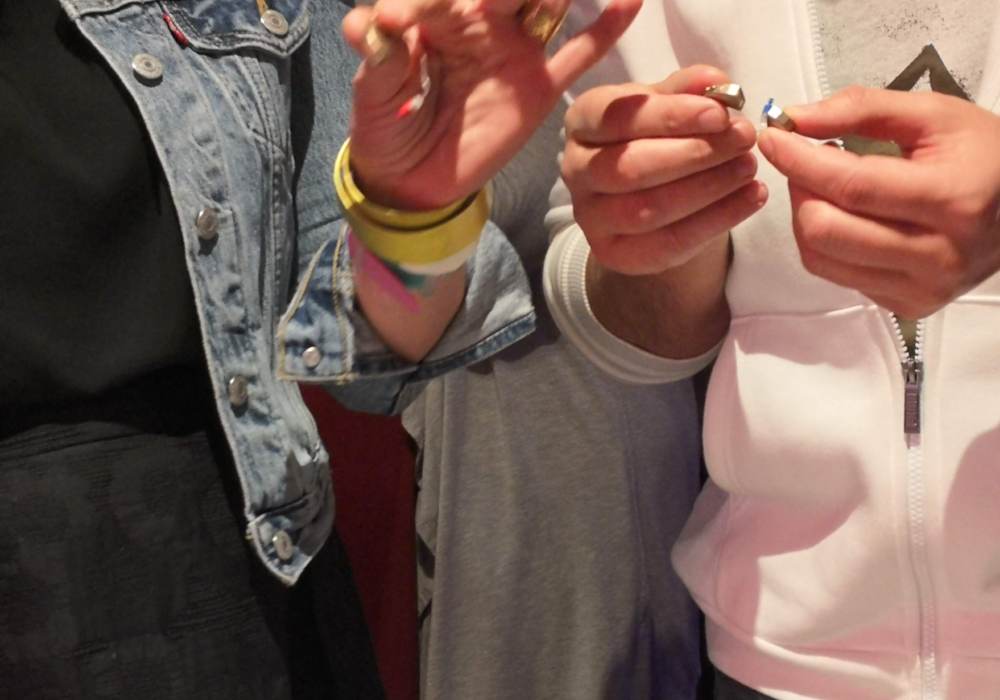
If you’ve ever watched an elderly relative change the battery in their hearing aid, or been asked to change one, imagine a world in which you’ve waited several days in deafness, because taking a new battery out of a blister pack is just too fiddly for you to manage at your age.
A ninety year old has less than perfect hand/ eye coordination. The default design of hearing aids, the design of battery blister packs and the trouble that even sighted people have in changing them over – because it is fiddly and easily muckable: (tell me I’m the only one who’s put the the old and the new battery down side by side and not know which one is which) and the picture of the problems that Leah is aiming to solve becomes clear.
Leah’s hearing aid design incorporates magnetised rechargeable batteries that snap in and out and form the entire lower half of the hearing aid.
The batteries dock in a kidney shaped box reminiscent of the hearing aid’s shape. This acts as a visual reminder to anyone looking at it what the box is for and what it does, which is helpful. You only need to look at it to know that it belongs with the hearing aid.
Because they’re magnetised is becomes more difficult to accidentally drop one and it becomes easier to pick it back up again.
This is brilliant engineering that resolves a real world problem.
If you missed Experimenta last night, do not despair. Check out this Meetup with RMIT Innovation and Entrepreneurship Research Group http://meetu.ps/e/FY1LD/66ySd/d
24 October PM join a panel of experts and the Victorian Law Foundation discussing whether sport and the law should be more like one another or not.
“Sport has its own codes of behaviour and its own judicial processes – which at times seem at odds with the general community. Issues like assault, bullying, drugs and discrimination can be managed differently on the field and off.”










 Tech and the City
You must be logged in to post a comment.